
Choosing the right tractor tires is essential for maximizing performance, efficiency, and long-term productivity in agriculture. To understand the broader role of tires in field operations, see our guide on Agricultural Tire Field Performance. reducing operating costs, and protecting long-term productivity.
The wrong tire can lead to excessive slippage, poor fuel efficiency, increased soil compaction, and unnecessary downtime.
This guide explains how to select tractor tires based on field conditions, tire construction, tread design, and load requirements.
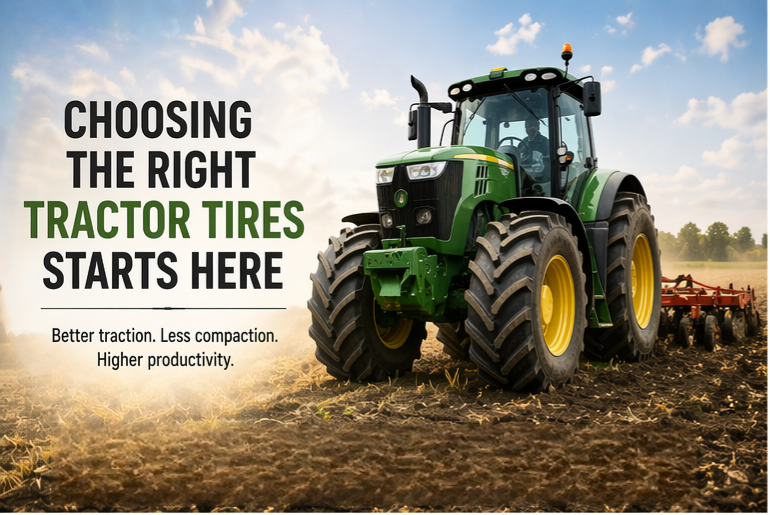
Understand Your Field Conditions First
Field conditions, soil management and machinery practices all influence long-term productivity. The Food and Agriculture Organization has emphasized the importance of sustainable soil management as a foundation for resilient agriculture.
Before choosing tractor tires, evaluate the conditions where the machine will operate.
Important factors include:
· Wet or dry soil
· Loose or compact ground
· Flat or uneven terrain
· Field work or transport use
Soft fields may require deeper tread and wider footprints, while mixed road-field applications may require different considerations.
Radial vs Bias Tractor Tires: Which Is Better?
For broader technical background on agricultural tire construction and operating principles, users may also consult resources from the American Society of Agricultural and Biological Engineers.
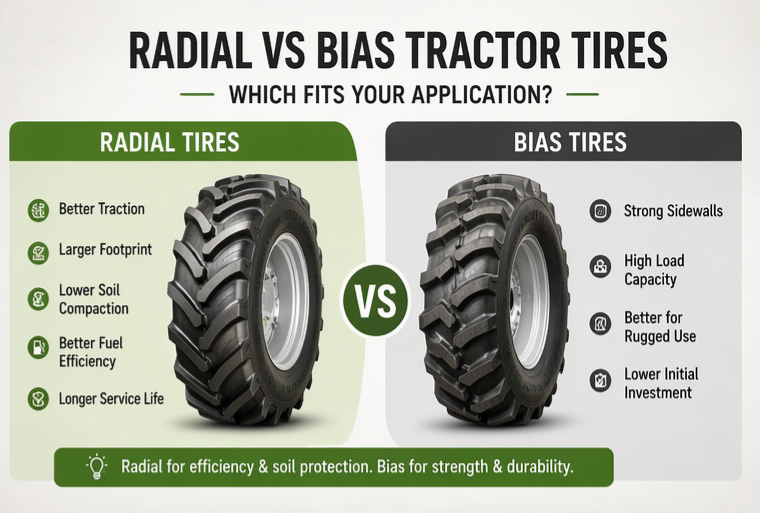
One of the first decisions is whether to choose radial or bias tires.
Caption:
Radial and bias tractor tires serve different applications depending on load, terrain and field conditions.
Benefits of Radial Tractor Tires
Radial tires typically offer:
· Better traction
· Larger footprint
· Reduced soil compaction
· Improved ride comfort
· Longer service life
For many modern farms, radial tires provide higher efficiency.
When Bias Tires Make Sense
Bias tires may still be suitable when:
· Heavy sidewall strength is needed
· Rugged conditions are common
· Lower initial investment is preferred
How to Select the Correct Tire Size
Tire size affects:
· Load carrying capacity
· Stability
· Ground pressure
· Field efficiency
Always consider:
· Equipment specifications
· Recommended OEM sizes
· Application requirements
Choosing the correct size improves both safety and performance.
Choosing the Right Tread Pattern
R-1 for General Farming
Suitable for standard agricultural applications.
R-1W for Wet Conditions
Deeper lug design helps improve traction in soft and muddy fields.
R-4 for Mixed Use
Designed for agricultural-industrial mixed applications.
Common Mistakes When Choosing Tractor Tires
Choosing tractor tires is not only about size or price. Many operators make selection mistakes that affect efficiency and increase long-term costs.
Common mistakes include:
Choosing Tires Based Only on Initial Cost
Lower upfront cost does not always mean lower operating cost.
A tire with poor traction or shorter service life may lead to:
· Higher fuel consumption
· More slippage
· Faster wear
· Increased replacement costs
· Long-term performance should be considered alongside purchase price.
Ignoring Field Conditions
A tire suited for dry soil may perform poorly in wet or muddy conditions.
Field conditions should always influence decisions regarding:
· Tread pattern
· Tire width
· Inflation pressure
· Load distribution
Matching tires to actual working conditions is critical.
Using the Wrong Inflation Pressure
Incorrect inflation pressure can reduce traction, increase wear, and contribute to soil compaction.
Maintaining proper pressure helps optimize:
· Ground contact
· Tire life
· Fuel efficiency
· Soil protection
Overlooking Load Requirements
Using tires not designed for the equipment load can create operational risks and reduce performance.
Always verify load ratings before selection.
Consider Load Capacity and Working Hours
Heavy loads and long operating hours require tires designed for durability and stability.
Proper load matching helps reduce:
· Downtime
· Premature wear
· Operational risk
Why the Right Tractor Tire Choice Matters
Reducing soil pressure is also critical for long-term productivity. Learn more about how tires impact soil in our guide on soil compaction in agriculture.
Selecting the right tractor tire can improve:
· Productivity
· Fuel efficiency
· Soil protection
· Long-term operating costs
Tire selection is not just compatibility—it is performance strategy.
UNIGLORY Tractor Tire Solutions
UNIGLORY agricultural tires are engineered for:
· Reliable traction
· Reduced soil compaction
· Heavy-load durability
· Real field performance
Explore our solutions:
FAQ
What is the difference between radial and bias tractor tires?
Radial tires generally offer better traction, larger footprints, and lower soil compaction, while bias tires may provide stronger sidewall strength in certain applications.
Are wider tractor tires better?
Wider tires can help reduce ground pressure and improve flotation, especially in soft soil conditions.
Which tread is best for muddy fields?
R-1W tread is often preferred for wet or muddy conditions due to deeper lug design.