
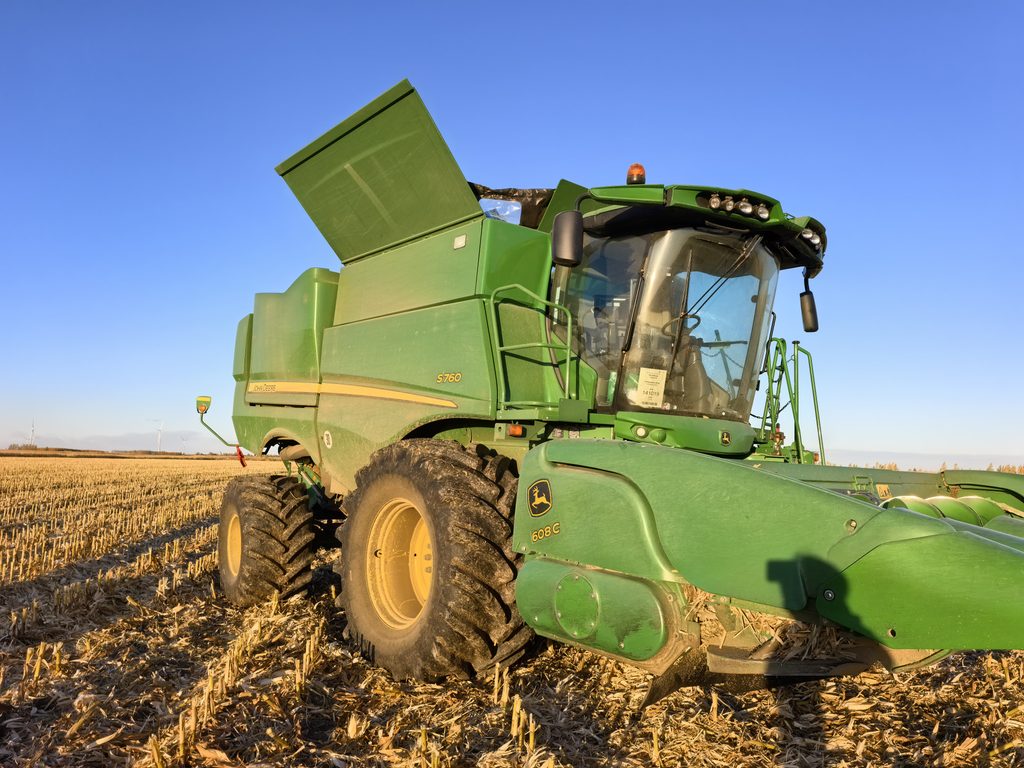
As heavy machinery moves across wet fields, tire selection and inflation pressure become important factors in managing soil compaction.
Harvesting rarely happens under perfect conditions. When rain delays fieldwork, growers often face a difficult choice: wait for the soil to dry or continue harvesting while conditions are less than ideal.
The decision can affect more than the current crop.
In a November 4, 2026 article published by Farm Progress, agricultural researchers highlighted the long-term risks of wheel-traffic compaction during wet harvest conditions. The report noted that yield losses associated with compaction can range from 10% to 20%, depending on field conditions and the severity of the damage.
For farmers operating heavy tractors, combines and grain carts, this raises an important question: How can tire selection help reduce the impact of machinery on agricultural soil?
Why Wet Soil Is More Vulnerable to Compaction
Healthy soil contains pore spaces that allow air, water and roots to move through the ground.
When heavy machinery passes over wet soil, those spaces can be compressed. Water infiltration may slow, root development can become restricted, and the effects may remain long after harvest.
The risk is particularly significant with heavy harvesting equipment. As machinery weight and axle loads increase, the pressure transmitted into the soil becomes an important consideration.
Not all compaction is visible at the surface. A field may show relatively shallow wheel tracks while deeper soil layers have already been affected.
This is why soil protection begins before machinery enters the field.
The Role of Agricultural Tires in Soil Protection
Agricultural tires provide the contact between machinery and the ground. Their dimensions, construction and inflation pressure influence how the machine’s weight is distributed.
A larger tire footprint can help spread the load over a wider contact area, reducing localized pressure at the soil surface.
However, tire width alone does not determine performance. Actual results depend on tire construction, load capacity, inflation pressure, machine configuration and soil conditions.
For this reason, selecting agricultural tires requires more than matching a tire size to a tractor.
1. Choose Tires for the Actual Machine Load
A tractor working with a heavy implement may place different loads on its front and rear axles.
Harvesters and grain carts also experience changing loads during operation.
Tire selection should account for the equipment’s operating weight, axle load, speed and intended application.
The correct load capacity is essential for both safe operation and tire performance.
2. Pay Attention to Inflation Pressure
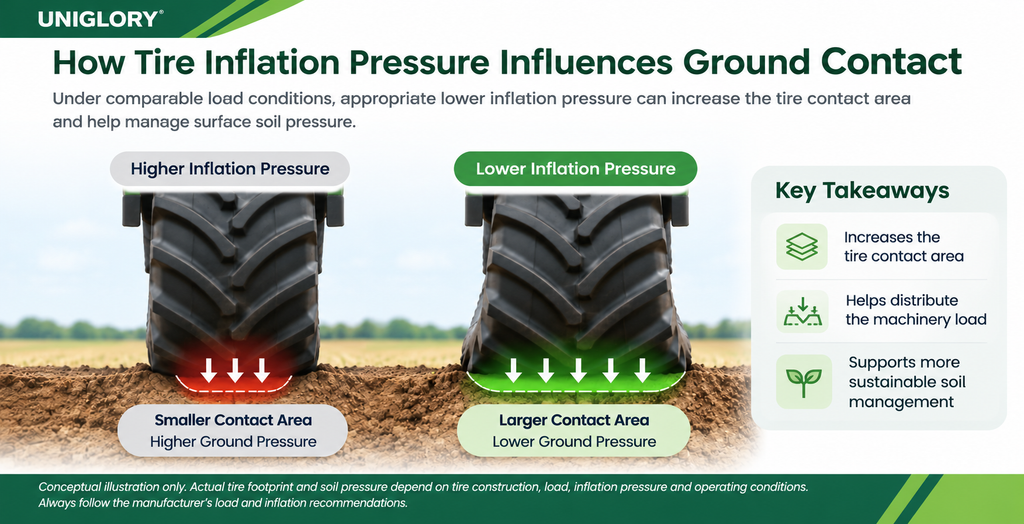
Inflation pressure plays an important role in the relationship between agricultural tires and soil.
Where the tire’s load and speed ratings permit, operating at an appropriate lower inflation pressure can increase the contact area and help reduce surface compaction.
Overinflation may reduce the tire footprint, while underinflation beyond the manufacturer’s recommendations can compromise tire performance and durability.
The objective is not simply to use the lowest possible pressure, but to use the correct pressure for the actual load and operating conditions.
3. Consider Radial and High-Flexion Tire Technology
Radial agricultural tires are designed with a flexible sidewall structure that can support a suitable footprint under operating loads.
IF (Improved Flexion) and VF (Very High Flexion) tire technologies offer additional load-and-pressure capabilities compared with conventional radial tires of equivalent size, subject to the applicable specifications.
These technologies can be useful for agricultural operations where load management, traction and soil protection are important.
The right choice depends on the machinery and its working requirements.
Beyond Tires: Managing Machinery Traffic
Even well-selected tires cannot eliminate soil compaction.
Field traffic management remains essential, particularly during wet harvesting conditions.
Reducing unnecessary passes, using established traffic lanes and limiting heavy machinery movement across vulnerable areas can help reduce the amount of soil exposed to wheel traffic.
Where practical, growers should also assess soil moisture before field operations and avoid moving heavily loaded equipment through the wettest areas.
Combining suitable tires with thoughtful field management offers a more practical approach than relying on tire technology alone.
Supporting Agricultural Operations with UNIGLORY
Different agricultural applications place different demands on tires. From tractors working in the field to harvesters operating under heavy loads, tire selection requires careful consideration of equipment weight, inflation pressure and ground conditions.
UNIGLORY offers agricultural radial tire solutions for a range of farming applications, including VF tire options designed to accommodate specific load and inflation requirements.
One example is the SMARTAGRO MASTER VF710/70R42 CFO (182D), featuring a 719 mm section width, 2,064 mm overall diameter and 63 mm tread depth. These specifications provide a useful starting point when evaluating tire options for agricultural machinery.
However, selecting a suitable tire involves more than comparing dimensions. Actual axle loads, operating speeds, recommended inflation pressures and field conditions must also be considered.
For growers and equipment partners, matching tire specifications to real operating requirements is an important part of managing machinery performance and protecting agricultural soil.
Explore UNIGLORY Agricultural Tire Solutions to learn more about our agricultural tire range.
Preguntas Frecuentes
¿Pueden los neumáticos agrícolas reducir la compactación del suelo?
Appropriately selected agricultural tires can help reduce surface pressure by distributing machinery loads over a suitable contact area. However, soil moisture, axle load, inflation pressure and field traffic patterns also influence compaction.
Are wider tractor tires always better for soil protection?
Not necessarily. Wider tires may offer a larger contact area, but the result depends on tire construction, load, inflation pressure and operating conditions. Tire selection should be based on the complete machinery application.
How does tire pressure affect soil compaction?
Inflation pressure influences the tire footprint and contact pressure at the soil surface. Correct inflation for the actual load and speed can help manage compaction while maintaining safe tire operation.
Can VF agricultural tires help protect soil?
VF tires can operate with different load-and-pressure capabilities from conventional radial tires of equivalent size. When properly specified and used, these characteristics can support soil-protection strategies. The actual benefit depends on equipment loads and field conditions.
References